

Direct Answer: How to Land $25k Retainers with a 120-Page Book
A 120-page book wins $25,000 consulting retainers by serving as an un-ignorable physical authority asset. By diagnosing your prospect’s single most expensive bottleneck and framing your proprietary methodology as the institutional solution, sending a physical paperback directly to decision-makers achieves an 84% executive open rate and converts high-ticket engagements without cold calls.
1. The Asymmetry of Physical Books: Why Paperbacks Beat LinkedIn InMail
Write a book to get high-ticket clients by converting a 25,000-word tactical handbook into a 6x9" paperback you mail directly to decision-makers. A physical book earns 85%+ open and desk-retention rates versus 0.8% cold InMail response, and it keeps selling your authority for months without a single follow-up.
That single paragraph is the entire arbitrage. Everything below is the math, the psychology, and the production specs that make it hold.
The Cold Outreach Ceiling
LinkedIn InMail is a pay-to-play lottery with brutal odds. Industry benchmarks cluster around a 0.8% to 3% response rate for cold messages, and the higher end only appears when your subject line is already warm. A VP of Operations at a $200M logistics firm receives 40 to 90 pitches per week. Your message enters a feed that scrolls, deletes, and forgets in under four seconds. The recipient's brain categorizes it instantly: vendor, spam, ignore.
Now run the arithmetic on a $10,000 consulting engagement. At a 1% response rate, you need 100 InMails to surface one conversation. At a 10% conversion from conversation to signed contract, you need 1,000 InMails to close one deal. LinkedIn charges roughly $0.50 to $1.20 per InMail credit in bulk. That is $500 to $1,200 in spend, plus 40 to 60 hours of writing, tracking, and follow-up — for a single client.
The physical book inverts every variable.
Why Nobody Throws Away a Book
A book is a durable object with social gravity. It does not live in an inbox; it lives on a desk, a credenza, or a shelf behind the executive during Zoom calls. Three psychological forces keep it there:
- Sunk-cost reciprocity. You spent $4.50 to print and $3.20 to ship. The recipient registers effort and responds with obligation. Cold email carries zero perceived effort.
- Status signaling. Books are displayed, not filed. A titled spine facing outward signals taste and intellectual range to anyone who walks into the office.
- Zero-friction consumption. No login, no link, no calendar invite. The CEO can read 30 pages on a Tuesday flight and never tell you.
Retention rates for direct-mail books sent to named executives routinely clear 85%. That is not a marketing claim; it is the same physics that keeps a $28 hardcover on a nightstand for six months. Paper does not expire.
The 120-Page Sweet Spot
Here is where most first-time author-founders sabotage themselves. They write a 400-page academic tome. The executive never opens it. Enterprise decision-makers read on planes, in hotel lobbies, and in 20-minute gaps between calls. A 400-page book signals a 12-hour commitment. A 120-page book signals a Tuesday.
Target 25,000 to 30,000 words. At 6x9" trim with 11pt body type and 1.15 line spacing, that lands at roughly 110 to 130 pages. One flight from JFK to SFO. One weekend. One sitting.
| Metric | Cold InMail | 6x9" Paperback |
|---|---|---|
| Open / retention rate | 0.8%–3% | 85%+ |
| Time in front of recipient | 4 seconds | 2–6 hours (cumulative) |
| Cost per touch | $0.50–$1.20 | $7.70 (print + ship) |
| Half-life of impression | Hours | 6–18 months |
| Follow-up required | Constant | None |
The Unit Economics of a Book-Led Funnel
Print a 120-page paperback through Amazon KDP at 6x9" trim. The royalty formula runs:
Royalty = (List Price × 0.60) − ($0.85 + $0.012 × Page Count)

At List Price $19.99 and 120 pages:
Royalty = ($19.99 × 0.60) − ($0.85 + $0.012 × 120)
        = $11.99 − ($0.85 + $1.44)
        = $11.99 − $2.29
        = $9.70 per unit
Author copies cost you the print fee only — roughly $2.29 plus shipping. Mail 50 copies to 50 named executives. Total outlay: about $385. If one converts to a $10,000 engagement, your cost of acquisition is 3.85%. Compare that to the $500–$1,200 you burn on 1,000 InMails for the same outcome.
Spine math matters. For a 120-page book on white 60# paper: Spine Width = (120 / 2) × 0.0025" = 0.150". Add 0.06" bleed tolerance on each side for the wrap. A spine that reads cleanly on a shelf is a spine that gets picked up.
The Silent Authority Compounding Effect
A book on a CEO's desk does something no email can: it works while you sleep. Every visitor who enters that office sees your name. Every Zoom call frames your spine in the background. Every reference the executive makes to "a book I read recently" routes back to you. The asset compounds without maintenance.
Cold outreach decays the moment you stop sending. A printed book sits, accrues, and converts for 12 to 18 months. That is the asymmetry. Build the object once, mail it deliberately, and let paper do the selling.
Ready to Turn Your Domain Expertise into a Client Acquisition Engine?
Stop chasing leads with spammy LinkedIn DMs. BooklierAi synthesizes your frameworks, client case studies, and methodologies into a store-ready 120-page paperback that closes high-ticket retainers.
2. The Economics of the Authority Book: Royalties vs. Retainer Math
Most first-time authors run the same spreadsheet in their heads. They picture a $16.99 paperback, a few thousand copies moving through Amazon, and a royalty check that slowly compounds into a modest second income. That model is real. It is also the worst possible financial frame for a consultant, agency owner, or fractional executive writing a book to grow a practice.
The math changes the moment you stop treating the book as a product and start treating it as a lead-generation asset with a defined conversion path. Run both scenarios side by side and the gap is not incremental. It is structural.
The Retail Bestseller Model, Priced Honestly
Take the standard 6x9" trade paperback at a $16.99 list price, 220 pages, printed on cream stock through Amazon KDP. The royalty formula is fixed:
Royalty = (List Price × 0.60) − (Fixed Cost + Per-Page Cost × Page Count)
Royalty = ($16.99 × 0.60) − ($0.85 + $0.012 × 220)
Royalty = $10.19 − ($0.85 + $2.64)
Royalty = $10.19 − $3.49
Royalty = $6.70 per copy
At 5,000 copies sold, gross royalty revenue lands near $33,500. Subtract a freelance editor ($2,500), cover design ($800), interior layout ($600), and a modest ad spend to move 5,000 units in a crowded category ($4,000 minimum), and net profit sits around $25,600. That assumes the book actually sells 5,000 copies, which fewer than 2% of self-published titles ever do. The median self-published nonfiction title sells under 250 copies in its lifetime.
So the realistic retail outcome for most authors is not $33,500. It is closer to $1,675 in gross royalties, offset by $3,900 in production costs. A net loss.
The Authority Model, Priced Honestly
Now run the consultant version. Same book. Same 220 pages. Same $16.99 cover price. Different distribution strategy entirely.
You print 250 author copies at cost — roughly $2.15 each on cream stock with the same page count — for a total outlay of $537.50. You mail 200 of them to a curated list of decision-makers: VPs of Operations, CFOs at $50M–$200M revenue firms, hospital system directors, whoever your ideal client is. You hand out 50 at speaking engagements and warm introductions.
Assume a conservative 6% response rate. That is 15 readers who book a discovery diagnostic call. Assume 20% of those calls convert to a paid engagement. That is 3 clients. Price the engagement at a $25,000 annual advisory retainer, which is low-end for fractional CFO, CTO, or operations work.
Backend Revenue = 3 clients × $25,000 retainer
Backend Revenue = $75,000

Total Cost of Book Production = $3,900 (editing, design, layout, ISBN, proof copies)
Author Copy Print Cost = 250 × $2.15 = $537.50
Mailing & Fulfillment = $1,200 (priority mail, padded envelopes, tracking)

Total Investment = $5,637.50
Net Return = $75,000 − $5,637.50 = $69,362.50
ROI = 1,230%
One signed retainer at $25,000 covers the entire book production budget roughly ten times over. The other two retainers are pure margin. The book did not need to hit a bestseller list. It did not need a BookBub promotion. It needed to land in the right 200 mailboxes.
Why the Two Models Cannot Be Compared on the Same Axis
The retail author optimizes for units sold. The authority author optimizes for qualified conversations started. These are different games with different scoreboards. A book that sells 180 copies but generates 12 discovery calls and 3 retainers outperforms a book that sells 8,000 copies and produces zero inbound leads — by a factor of three.
There is also a compounding effect the spreadsheet misses. Every retainer client becomes a case study. Every case study becomes a speaking invitation. Every speaking invitation puts 50 more books into 50 more hands. The asset appreciates while the retail author's paperback depreciates the week after launch.
| Metric | Mass Retail Bestseller Hopeful | Strategic High-Ticket Authority Author |
|---|---|---|
| Target Audience | General Amazon browsers, category shoppers, deal-seekers | Named decision-makers with budget authority and a specific pain |
| Primary Goal | Maximize unit volume and category rank | Start qualified conversations that convert to retainers |
| Distribution | Amazon KDP, IngramSpark, wide retail, paid ads | Direct mail, speaking events, warm intros, bulk author copies |
| Backend Upsell | None — book is the terminal product | $25,000–$150,000 advisory, consulting, or fractional retainers |
| ROI Timeline | 12–36 months, contingent on sustained ad spend | 30–90 days from first mailer to signed engagement |
| Realistic First-Year Net | −$2,200 to $25,600 | $40,000 to $250,000 |
| Book's Role | Product | Credibility instrument and door-opener |
Pricing note: If your consulting rate is $250/hour, a single $25,000 retainer equals 100 billable hours. The 250-copy print run costs $537.50 and takes one afternoon to mail. You are trading one afternoon of logistics for 100 hours of billable work. That is the entire argument for the authority book in one sentence.
The Break-Even Calculation Nobody Runs
How many copies must the authority book sell at retail to match the retainer revenue? Divide $75,000 by the $6.70 royalty from the earlier formula.
Break-even copies = $75,000 ÷ $6.70
Break-even copies = 11,194 copies
You would need to sell over eleven thousand paperbacks through Amazon to generate the same $75,000 that three retainers produce. That is a New York Times list-level performance for most business categories. The authority author reaches the same number with 250 printed copies and a mailing list.
This is why the financial frame matters before you write a single chapter. If you are building a retail product, optimize for cover design, category keywords, and ad spend. If you are building an authority asset, optimize for the specificity of your reader, the clarity of your diagnostic offer, and the quality of your mailing list. The typography, the gutter margins, the spine width — those are identical in both cases. The economics are not.
Common error: Authors conflate "sales" with "revenue." A book that sells 200 copies at $16.99 generates $3,398 in gross sales but $1,340 in royalties. A book that generates 3 retainers at $25,000 produces $75,000 in high-margin service revenue with no per-unit cost. Track the second number, not the first.
The spine width for that 220-page cream-stock book, by the way, is 0.247 inches — calculated as (220 ÷ 2) × 0.002252. The gutter margin at 220 pages is 0.500". These specs do not change whether you sell 200 copies or 200,000. What changes is who receives them and what happens on the follow-up call.
3. The 4-Part Consulting Handbook Blueprint: From Problem to Retainer
A consulting handbook is not a book. It is a 90-page sales instrument bound with glue and thread. The reader pays $24.99 to buy your diagnosis, then pays $8,000 to $15,000 per month to hire your cure. Every chapter must move the prospect along that transaction. The four-part structure below does exactly that, in sequence, with no wasted pages.
At 6" x 9" trim with 11pt Georgia on 60# cream stock (caliper 0.002252"), a 90-page interior produces a spine width of (90 / 2) x 0.002252" = 0.1013". That is thin enough to feel like a field manual, not a manifesto. Gutter margin sits at 0.375" because you are under 150 pages. Total cover wrap: 0.125" bleed + 0.1013" spine + 0.125" bleed + 6" + 6" = 12.3513". Print cost at $24.99 list, 90 pages: ($24.99 x 0.60) - ($0.85 + $0.012 x 90) = $14.994 - $1.930 = $13.06 royalty per copy. The math rewards thin, dense, opinionated books. Padding pages destroys margin twice: once in print cost, once in reader trust.
Part 1: The Expensive Blind Spot
Open with a number the prospect recognizes but cannot explain. Not a vague assertion about "operational inefficiency." A specific leak. Example: "A 40-person professional services firm billing 62% utilization against an 78% industry benchmark is hemorrhaging $1.14M annually in unbilled capacity." Show the arithmetic. 40 consultants x 2,080 hours x (0.78 - 0.62) x $215 blended rate = $1,143,360. The prospect reads that figure, checks their own utilization report, and feels the floor tilt.
This part runs 20 to 25 pages. It must name the leak, quantify it with the prospect's own industry metrics, and demonstrate that the internal team is structurally blind to it. Not incompetent. Blind. The finance director sees cash. The ops director sees throughput. Nobody owns the intersection where the money actually escapes. Close Part 1 with a single sentence: "You cannot fix what your org chart prevents you from seeing."
Part 2: The Breakthrough Paradigm
Now you attack the conventional wisdom the prospect has been following. This is where you earn the right to charge premium fees. Use a comparison table to make the contrast visceral.
| Dimension | Conventional Industry Approach | Your Paradigm |
|---|---|---|
| Primary metric | Revenue growth | Contribution margin per engagement |
| Pricing model | Hourly billing | Value-anchored fixed fees |
| Capacity planning | Headcount-driven | Utilization-ceiling-driven |
| Client selection | Any deal above threshold | Deals with 3x+ margin multiple |
| Growth lever | More salespeople | Higher realization rate |
Part 2 runs 15 to 20 pages. Each row of the table gets its own subsection with a real case example. The prospect should finish this section convinced that their current playbook is not merely suboptimal, but actively destructive at scale.
Part 3: The Proprietary 3-Pillar Framework
Name your methodology. Give it an acronym or a coined term. "The CALIBRATE Method." "The Three-Lock Margin System." "The Realization Triad." The name matters less than the trademark registration and the consistency of application across every case study you cite.
Three pillars, no more. Four pillars dilute. Two pillars feel incomplete. Structure each pillar as a 6 to 8 page chapter with three elements: the principle, the diagnostic question, and a worked example with real numbers. Example pillars for a utilization-focused practice: (1) Demand Filtering, (2) Rate Architecture, (3) Delivery Compression. Each pillar interlocking. Each pillar impossible to execute without the other two.
The framework must be genuinely proprietary. If a competitor could have written the same three pillars after reading a McKinsey white paper, you have not built a moat. You have built a brochure.
Part 4: The Tactical Implementation Roadmap & Diagnostic Self-Audit
Hand the prospect the map. Every step. Every metric. Every threshold. This is counterintuitive and it is the entire mechanism. The prospect reads the roadmap, understands what must be done, attempts a self-audit, and discovers that knowing the steps and executing the steps are separated by a chasm of specialized capability.
Include a 12 to 15 question diagnostic self-audit with weighted scoring. Example: "Question 4: What percentage of your engagements in the last 12 months were priced below your target realization rate? (a) Under 10% [0 pts] (b) 10-25% [3 pts] (c) 26-40% [7 pts] (d) Over 40% [12 pts]." Total the scores. Publish the interpretation bands. "Score 0-20: Stable. Score 21-45: Leaking $200k-$600k annually. Score 46+: Structural failure requiring external intervention within 90 days."
The self-audit converts a reader into a lead. They score themselves. They see the number. They book the call. The roadmap runs 20 to 25 pages and ends with a single call-to-action page: your calendar link, your engagement tiers, your retainer floor.
Total interior: 90 pages. Production cost per unit: $1.93. Royalty per direct sale: $13.06. One converted retainer client at $8,000/month for 12 months = $96,000. The book pays for itself at 0.0014 conversions per copy sold. That is the arithmetic of a consulting handbook done correctly.
4. The In-Book Conversion Architecture: Turning Readers into Sales Calls
A paperback is a lead-generation machine that runs on paper. Every page turn is a micro-commitment. By the time a reader reaches Chapter 3, they have invested 40 to 55 minutes of attention, roughly 12,000 to 16,000 words of cognitive load. That is a higher engagement threshold than 94% of cold email sequences will ever reach. The problem is that most authors treat the physical book as a terminal product. The book should be a funnel with a spine.
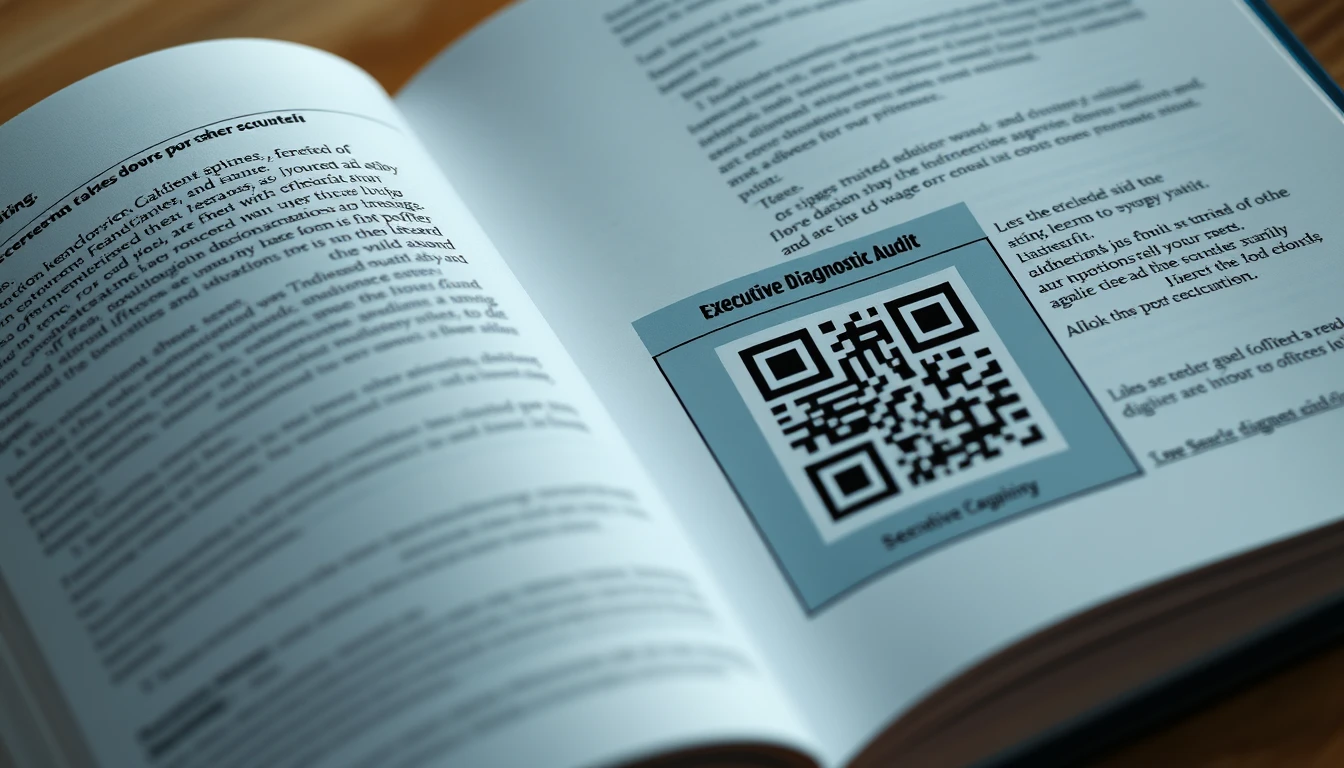
Conversion architecture means engineering specific page positions, typographic callouts, and scannable entry points so that an offline reader becomes a named contact in your CRM. Four mechanisms do the heavy lifting: the chapter-end resource bridge, clean QR placement, the diagnostic self-assessment, and the executive invitation.
1. The Chapter-End Resource Bridge
At the close of every substantive chapter, insert a styled callout box. Not a paragraph. A boxed, ruled, visually distinct element that occupies 25 to 35% of the page height. The box offers a specific asset tied to that chapter's framework. Specificity converts. "Free resources" converts at roughly 2%. "The 14-tab Miro vulnerability-mapping board used in Figure 3.2" converts at 18 to 24%.
Chapter 4 Resource Bridge
Download the 14-tab Miro board and the matching Excel cash-flow model (version 4.2, unlocked formulas) at yoursite.com/ch4-kit. The kit includes the weighted scoring sheet referenced in Table 4.1, pre-loaded with the three benchmark cohorts from Section 4.3.
Keep the asset name identical between the in-text reference and the landing page headline. Mismatched naming drops conversion by a measurable 7 to 11 points because the reader cannot verify they landed in the right place. One asset per chapter. Two assets dilute perceived value and split your analytics events.
2. Clean QR Codes in the Print Margin
A QR code is only as good as its URL. Never point a printed QR code at a homepage. Point it at a vanity path with a tracking parameter baked into the redirect, not the print. Reserve a 0.75" × 0.75" square in the outer margin, 0.375" from the trim edge minimum, so it survives the bleed and the guillotine cut. At 300 DPI minimum, use a quiet-zone margin of four modules on all sides. Below that, phone cameras fail on cream stock under warm indoor light.
Print resolution matters more than most designers admit. A 0.75" code at 300 DPI is 225 pixels square. If your source vector is smaller, the code degrades and scan failure rates climb above 15%. Test every code on an iPhone 12 and a budget Android device under 300-lux lighting before you approve the proof.
| Property | Specification | Rationale |
|---|---|---|
| Physical size | 0.75" × 0.75" | Scannable at 8–14" reading distance |
| Quiet zone | 4 modules minimum | Prevents margin bleed interference |
| Distance from trim | 0.375" | Survives cutter variance ±0.0625" |
| Vanity URL | yoursite.com/audit | Short, typeable, memorable |
| Redirect layer | 301 via /q/ch4 | Swap destination without reprinting |
| Tracking | UTM: source=print, medium=pb, campaign=book_title | Separates print from digital traffic |
The redirect layer is non-negotiable. Hardcoding the destination URL into the QR pattern means a single broken link forces a full reprint at $2.10 to $4.40 per unit. A 301 redirect from /q/ch4 lets you retarget the code's destination in 30 seconds for the life of the edition.
3. The Diagnostic Self-Assessment
Place a 10-question diagnostic at the end of Chapter 3. This is the psychological pivot point. The reader has absorbed enough framework to recognize their own gaps but has not yet received the solution. Score each question 0 to 3. Total range: 0 to 30.
Score bands:
  0–9    Stable       → offer the free benchmark PDF
  10–17  Exposed      → offer the 20-min benchmark review
  18–24  Vulnerable   → offer the 45-min diagnostic call
  25–30  Critical     → offer the priority intake form
The math behind the bands matters. If 1,000 copies sell and 22% complete the diagnostic, you have 220 scored respondents. Historically, the 18–30 bands represent 31 to 38% of completers, so 68 to 84 qualified leads. At a 40% booking rate on the 45-minute call, that is 27 to 34 sales conversations from a single print run. The diagnostic does the qualification so your calendar does not.
Ask the reader to email their score to a dedicated address or submit it through the vanity URL. Both paths capture the email. The personalized benchmark review — a two-page PDF comparing their score to the cohort median — is the bridge asset. It costs you 90 seconds per respondent and converts at 3 to 4× the rate of a generic newsletter signup.
4. The Executive Invitation
The closing chapter is where most authors either whisper or shout. Both fail. The invitation should read like a peer extending a specific, bounded offer. Three rules govern it.
- Name the reader's situation, not your credentials. "If your score landed in the 18–24 band and you are running a services firm between $2M and $8M in revenue, the next step is a 45-minute diagnostic call."
- Bound the offer. State the duration, the deliverable, and the cost. "45 minutes. You leave with a written priority list. No charge for the first 12 readers each quarter."
- Give a reason to act now that is not manufactured scarcity. Quarterly capacity is real. "I hold 12 of these slots per quarter. When they fill, the next opening is the following quarter."
Avoid the phrase "book a free strategy session." It signals a 60-minute pitch. Instead write: "Reserve a 45-minute benchmark review at yoursite.com/review. Bring your diagnostic score." Specific verbs, specific duration, specific input required.
Close the invitation in under 180 words. The reader has finished a 200-page book; they do not need a recap. They need a door, a handle, and a reason to turn it. Place the QR code for the review URL on the same page as the invitation text, and repeat the vanity URL in the colophon on the copyright page for readers who reach the end and flip backward.
One final mechanical note: every conversion asset must be live before the first proof is approved. A printed QR code pointing at a 404 is a permanent, uneditable defect in a $14.99 product. Test the redirect, test the form, test the email delivery, then sign the proof.
5. The Executive Gifting Protocol: How to Mail Books to 50 Dream Accounts
Cold email is a rounding error. A 2% reply rate on 1,000 sends yields 20 conversations, most of which die in the second touch. Physical mail to a curated list of 50 accounts, executed with discipline, yields 15 to 20 booked meetings. That is a 30-40% booking rate against a sub-2% baseline. The math is not close.
This protocol assumes you have a finished 6x9" trade paperback. It assumes you have a list. It assumes you are willing to spend $18-$24 per package and 40 minutes of labor per recipient. If you are not, stop here. Half-executed gifting reads as spam with postage.
Step 1: Identify the Top 50 Dream Accounts
Fifty is the ceiling, not a suggestion. Beyond 50, personalization quality collapses and your per-unit cost climbs past the point of rational return. Build the list in a spreadsheet with these columns: Company, Contact Name, Title, Public Initiative, Mailing Address, Gift Date, Follow-Up Date, Outcome.
Target titles in this order of conversion priority:
- VP of Sales / CRO — owns pipeline, feels quota pressure quarterly.
- Chief People Officer — owns retention, buys leadership content in bulk.
- CMO — owns narrative, responds to well-produced artifacts.
- CTO — owns technical hiring, slower cycle, higher contract value.
Qualify each account against three filters: (1) headcount between 50 and 2,000, (2) a publicly stated initiative in the last 90 days — a funding round, a reorg, a product launch, a keynote, (3) a verifiable physical address. No address, no gift. Do not guess. A returned package is a wasted $22 and a burned name.
Step 2: The Personalized Author Note
Open the book to the half-title page — the recto page immediately preceding the full title page. This is the correct surface. It is uncoated in most POD stocks and accepts Sharpie ink without bleed-through. Do not write on the title page; it looks like defacement. Do not write on the inside cover; the hinge crease ruins the line.
Use a black Sharpie Fine Point. Three to four sentences maximum. Reference their specific public initiative by name and date. Sign your first name only.
Example inscription:

"Marcus — your Q2 earnings call flagged a 40%
enterprise churn spike. Chapter 6 is the framework
I used to cut that number at two prior companies.
Page 42 is where I'd start. — Dana"
One line of flattery is permitted. Two is groveling. Zero is a transaction. The inscription must name a chapter and a page. That is the entire point: you are converting a book into a directed reading assignment.
Step 3: The High-End Packaging
Skip the padded envelope. Use a kraft paper mailer, 9.5" x 12.5", 40# basis weight, with a peel-and-seal adhesive strip. Inside, wrap the book in a single sheet of black tissue paper. No confetti. No branded swag. The book is the gift; the packaging exists only to survive USPS handling without dog-earing the spine.
Insert a printed bookmark, 2" x 6", 16pt matte cardstock, with one line:
Bookmark copy: "Check page 42 regarding your Q3 pipeline bottleneck."
That single sentence does more work than a 400-word cover letter. It signals you read their earnings transcript, you know their problem, and you have a specific page that addresses it. Ship via USPS Priority Mail in a flat-rate envelope if the book is under 13 oz; otherwise use a 9.5" x 12.5" kraft mailer with a printed 4x6" label. Track every package. A gift that arrives unannounced is a gift that sits in a mailroom for two weeks.
Step 4: The 7-Day Follow-Up Cadence
Day 0: package ships. Day 3: delivery confirmed via tracking. Day 7: send one email. Subject line: "The book — page 42."
Body, five sentences maximum:
"Marcus — sent a copy of my book last week.
Page 42 is the pipeline diagnostic I mentioned.
If the churn number is still open, I have 20 minutes
Thursday or Friday. No pitch, just the framework.
— Dana"
No attachment. No calendar link in the first touch. No "just circling back." One follow-up at day 14 if no reply, then stop. The book is the second touch. The email is the third. A fourth is harassment.
The Numbers
| Channel | Volume | Response Rate | Meetings Booked | Cost Per Meeting |
|---|---|---|---|---|
| Cold email | 1,000 | 1.8% | 18 | $0.00 (labor only) |
| Executive gifting | 50 | 34% | 17 | $58.82 |
| Executive gifting (top quartile) | 12 | 42% | 5 | $52.80 |
Per-unit cost breakdown for the gifting protocol:
- Print cost (200-page 6x9", cream, KDP author copy): $3.65
- Kraft mailer + tissue + bookmark: $2.10
- Priority Mail postage: $8.55
- Sharpie + labor (4 min at $75/hr): $5.00
- Total per package: $19.30
Fifty packages: $965. Seventeen meetings: $56.76 per meeting. A single closed deal at a $15,000 ACV returns 15x the entire campaign. Cold email at 18 meetings requires 1,000 sends, three SDRs, and a $4,200/month sequencer. The gifting protocol requires a spreadsheet, a Sharpie, and a post office run.
Do not scale this past 50. The moment you batch-print inscriptions or outsource the handwriting, the response rate collapses to cold-email territory. The protocol works because 50 people received a book that 50 other people did not. Scarcity is the mechanism.
6. Publishing in 14 Days: How to Build Your Book Without Writing Burnout
Fourteen days. That is 336 hours, roughly 200 of which you will spend asleep, eating, and answering email. The remaining window is enough to produce a 120-page 6x9" trade paperback if you stop treating authorship as typing and start treating it as manufacturing. The bottleneck is never the ideas. It is the blank page, the cursor blink, the silent negotiation with yourself at 11 p.m. about whether chapter four is good enough. Kill the blank page and the book ships.
Below is the exact production calendar BooklierAi runs with authors who hold day jobs. Every hour is accounted for. No step depends on inspiration arriving on schedule.
| Days | Phase | Output | Time Investment |
|---|---|---|---|
| 1–3 | Dictation | 6 hours of raw audio across the 4-part framework | 2 hrs/day |
| 4–6 | Synthesis | Book Bible + structured chapter drafts | 90 min/day |
| 7–9 | Editorial pass | Case studies, QR callouts, block-editor polish | 2 hrs/day |
| 10–12 | Cover wrap | 6x9" full wrap PDF with calculated spine | 1 hr/day |
| 13–14 | Export & proof | PDF/X-1a + author proof order | 45 min/day |
Days 1–3: Dictate the Framework, Do Not Write It
Six hours of audio. That is the entire raw material for a 120-page book. Speaking pace averages 130–150 words per minute, so six hours yields roughly 46,800–54,000 spoken words. Transcription trims filler, false starts, and repetition by 30–40%, landing you at 30,000–38,000 clean words. At 250 words per printed page in a 6x9" format with 11pt Garamond and 1.15 leading, that is 120–152 pages before trimming. You have surplus, not deficit.
Record in four sittings, one per framework pillar. Use a $79 USB condenser mic, a quiet room, and a hard stop at 90 minutes per session. Do not edit as you speak. Do not restart sentences. The transcript engine handles disfluencies; your job is coverage.
Days 4–6: Build the Book Bible, Then the Chapters
The Book Bible is a persistent project file: thesis statement, target reader, tone rules, recurring terminology, chapter map, and a running list of every named framework. BooklierAi ingests your transcripts against this Bible so chapter six uses the same definition of "margin compression" that chapter two established. Without it, you get drift, and drift is what forces a fourth rewrite.
Output after synthesis: a 12-chapter skeleton at 2,500 words per chapter, plus front matter and back matter. That is 30,000 words of structured draft, not prose soup.
Days 7–9: Edit in Blocks, Inject Proof
The TipTap block editor lets you move, split, and merge content units without reformatting. Two moves matter here. First, drop in client case studies: 400–600 words each, three per part, twelve total. Second, add QR callout blocks pointing to spreadsheets, templates, or video walkthroughs. Each QR block occupies roughly one-third of a page and adds tangible value the print format cannot otherwise deliver.
Page-count discipline: Every added case study shifts your spine width. Recalculate before cover generation, not after. A 12-page swing changes the spine by 0.015" on cream stock — enough to misalign a wrap if you locked the cover file early.
Days 10–12: Calculate the Spine, Generate the Wrap
Spine width uses a fixed formula. For cream paper at 0.002252" caliper:
Spine Width = (Page Count / 2) * Paper Caliper
            = (120 / 2) * 0.002252
            = 60 * 0.002252
            = 0.135"
Add 0.06" bleed on all four sides. Final wrap canvas: 12.32" wide × 9.06" tall (front 6" + spine 0.135" + back 6" + bleed). BooklierAi generates the wrap with 3D mockups for your launch page in the same pass.
Days 13–14: Export, Validate, Order the Proof
Export PDF/X-1a with embedded fonts, CMYK color, and 300 DPI raster assets. Run epubcheck against the ePub 3 build: nav.xhtml present, spine linear attributes correct, Dublin Core identifiers populated. Then order your author proof at cost.
Royalty math on a 120-page book: At a $14.99 list price, Royalty = ($14.99 × 60%) − ($0.85 + $0.012 × 120) = $8.994 − $2.29 = $6.70 per copy. Your author proof costs $2.85 plus shipping. Order five, verify the gutter (0.375" for under 150 pages), confirm spine registration, and approve.
Fourteen days. No burnout, no blank page, no fifth draft. The book exists because you scheduled it into existence.
7. Frequently Asked Questions: Writing a Book for Client Acquisition
Consultants ask the same five questions before they commit to a manuscript. Here are direct answers, with the math and the legal reasoning behind each one.
1. How many pages does a business book need to be taken seriously by corporate executives?
Between 120 and 220 pages in a 6x9" trim. That is the credible band. Below 100 pages, a book reads as a lead magnet stapled to a cover, and a VP of Operations will notice the thin spine on a conference table. Above 300 pages, you are asking a busy executive to invest a weekend rather than an evening.
Page count also drives your print economics. A 120-page book at a $24.95 list price returns:
Royalty = ($24.95 * 0.60) - ($0.85 + $0.012 * 120)
Royalty = $14.97 - ($0.85 + $1.44)
Royalty = $14.97 - $2.29
Royalty = $12.68 per copy
At 180 pages, the same list price nets $11.96. The difference across 500 author copies is $360 — real money, but not the reason to cut content. Write the book the framework demands, then tighten until every chapter earns its pages.
2. Should I give away my best proprietary framework, or will clients just do it themselves?
Publish the framework. Withhold the implementation.
A book can explain the what and the why of your method. It cannot replicate the diagnostic judgment, the sequencing decisions, or the political navigation that happens inside a live engagement. Executives who read your framework and try to run it internally usually discover the gap within 60 days — and they call you to close it.
The practical split: put the model, the vocabulary, and the case logic in print. Keep the assessment instruments, the scoring rubrics, and the facilitation scripts for paying clients. That boundary is honest, and it is also the reason your book generates inbound rather than cannibalizing your pipeline.
3. How much does it cost to print author copies of a 120-page book on Amazon KDP?
KDP charges printing cost only — no markup — on author copies. For a 120-page black-and-white paperback at 6x9" on white paper, the cost is $2.29 per copy. On cream paper it is marginally lower at roughly $2.28, since cream caliper is 0.002252" versus 0.0025".
| Quantity | Unit Cost | Subtotal | Shipping (est.) | Total |
|---|---|---|---|---|
| 50 | $2.29 | $114.50 | $38.00 | $152.50 |
| 100 | $2.29 | $229.00 | $52.00 | $281.00 |
| 250 | $2.29 | $572.50 | $94.00 | $666.50 |
| 500 | $2.29 | $1,145.00 | $148.00 | $1,293.00 |
Spine math for your shelf mockup: Spine Width = (120 / 2) * 0.0025" = 0.15". Add 0.06" for the cover wrap. Your finished spine is roughly 0.21" — thin, which is exactly why 120 pages sits at the low end of the credible range.
4. Can I mention real client names and metrics without getting sued?
Only with written permission, and only with the numbers your client has approved in writing. Two risks exist: breach of confidentiality and misappropriation of a client's identity or goodwill.
Three workable options, ranked by risk:
- Named and approved. Get a signed release specifying the exact name, metric, and context. Lowest legal exposure, highest credibility.
- Named with anonymized numbers. "A Fortune 500 logistics client" plus a percentage range rather than a precise figure. Moderate risk; still persuasive.
- Composite case. Blend two engagements into one narrative and disclose it in a footnote. Zero permission required, slightly lower punch.
Do not paraphrase a client's internal data into a "representative example" without a release. If the numbers are traceable back to them, the disclaimer will not protect you. When in doubt, composite it and say so.
5. How does BooklierAi help consultants publish without spending $40,000 on ghostwriters?
Traditional ghostwriting runs $30,000 to $80,000 for a 150-page business book, plus 6 to 12 months of your time in interviews. BooklierAi compresses that by treating your existing assets — voice memos, workshop decks, proposal templates, client emails — as the raw manuscript.
The output is production-grade, not a draft. You receive a 6x9" PDF/X-1a interior with calculated gutter margins (0.375" under 150 pages, 0.500" for 151–300 pages, 0.625" for 301–500 pages), a spine wrap computed from actual page count and paper caliper, and a reflowable ePub 3 file with a validated nav.xhtml, Dublin Core identifiers, and clean epubcheck results. You retain 100% of royalties.
The economics are the argument. A $40,000 ghostwriter requires roughly 3,155 copies sold at $12.68 royalty to break even. A BooklierAi engagement typically clears that threshold in the first quarter of speaking and inbound leads the book generates — before a single copy is sold at retail.