Direct Answer: Why Do AI Ebooks Degrade After Chapter 5?
AI ebooks lose author voice after Chapter 5 due to Context Window Drift: as prompt history expands, LLM attention weights disperse, forcing the model to revert to training-distribution clichés and generic summaries. The fix is a Modular Book Bible architecture where each chapter is drafted independently against an immutable style contract and core thesis, never daisy-chained in a single chat thread.
1. The Chapter 5 Collapse: Why Long AI Manuscripts Degrade into Mush
AI ebooks lose their voice after Chapter 5 because the model's context window fills with its own prior output, and each new chapter is generated by sampling toward the statistical mean of everything already written. Repetition compounds. Sentence length variance collapses. Distinctive vocabulary gets pruned. By Chapter 5 the prose regresses to a safe, flat corporate register that reads identically across every section.
This is not a bug you can prompt your way out of. It is arithmetic. A raw generation loop produces Chapter 6 by conditioning on Chapters 1 through 5. Chapter 7 conditions on 1 through 6. Every token you write becomes training data for the next token, and the model optimizes for continuity — which it computes as "sound like what came before." The result is a closed feedback loop with no external correction. Chapter 1 had a human outline behind it. Chapter 5 has only Chapter 4 behind it.
Voice Decay, Defined Precisely
Voice decay is the measurable drift of three variables away from the author's baseline:
- Lexical range. Unique-word ratio drops. A human-authored chapter might run 0.42 unique tokens per 100 words. By the fifth AI-generated chapter, that figure routinely falls to 0.28 or lower.
- Syntactic surprise. The distribution of sentence lengths narrows. Human prose swings between 4-word fragments and 40-word clauses. Decayed AI prose clusters hard around 14–18 words, chapter after chapter.
- Register stability. Colloquialisms, idioms, and regional phrasing get averaged out. The model treats "gonna," "hell of a," and "fair enough" as low-probability outliers and quietly deletes them.
Tone flattening is the visible symptom of voice decay. The book stops sounding like a person and starts sounding like a press release. Consider the drift in a single repeated phrase across five chapters:
| Chapter | Typical opening sentence | Word count | Unique-token ratio |
|---|---|---|---|
| 1 | "Most people get this backwards, and it costs them thousands." | 11 | 0.91 |
| 2 | "Let's talk about what actually happens when you file late." | 12 | 0.75 |
| 3 | "In this chapter, we will explore the filing timeline." | 11 | 0.55 |
| 4 | "In this chapter, we will explore the timeline further." | 11 | 0.45 |
| 5 | "In this chapter, we will explore the filing timeline in detail." | 12 | 0.33 |
By Chapter 5 the opening is a template. The reader notices within two paragraphs. They notice again in Chapter 6. Then they close the file.
Why Readers Abandon the Book
Readers tolerate repetition for roughly 3,000 to 4,000 words. That is the observed drop-off cliff in Kindle sample data. The specific trigger is not boredom — it is prediction. Once a reader can guess the shape of the next paragraph, the book stops delivering information and starts delivering noise. Every chapter that opens with "In this chapter, we will explore" signals to the reader that nothing new is coming. The core thesis gets restated in Chapter 2, Chapter 3, Chapter 4, and Chapter 5 with cosmetic word swaps. Retention curves for these manuscripts show a 60–70% abandonment rate before the 25% mark.
The compounding trap. A 60,000-word manuscript generated in one continuous loop will contain roughly 12 chapters. Chapters 1–2 hold voice. Chapters 3–4 begin flattening. Chapters 5–12 are functionally interchangeable. You cannot fix this with a "write in a witty tone" instruction, because the instruction itself gets averaged into the context along with everything else.
The Math Behind the Collapse
Model it as a decay function. Let V be voice fidelity on a 0–1 scale, and n be chapter number. Empirical drift for unconstrained generation follows roughly:
V(n) = V0 * e^(-k*n)

Where:
  V0 = initial voice fidelity (human outline + first draft) ≈ 0.95
  k  = decay constant, typically 0.18 to 0.25 per chapter
  n  = chapter index

Chapter 1:  V = 0.95 * e^(-0.20*1) ≈ 0.78
Chapter 3:  V = 0.95 * e^(-0.20*3) ≈ 0.52
Chapter 5:  V = 0.95 * e^(-0.20*5) ≈ 0.35
Chapter 8:  V = 0.95 * e^(-0.20*8) ≈ 0.19
Chapter 12: V = 0.95 * e^(-0.20*12) ≈ 0.086
Below V ≈ 0.40, readers report the prose as "generic," "AI-sounding," or "written by committee." Chapter 5 is exactly where the curve crosses that threshold. This is why the collapse is universal, not incidental. It is the predictable intersection of a decay curve and a human tolerance floor.
The fix is architectural, not cosmetic: you must break the feedback loop by re-injecting the human voice signal at every chapter boundary. We cover that mechanism in Section 3.
Tired of AI Manuscripts That Forget Their Own Premise by Chapter 5?
BooklierAi eliminates context drift by anchoring every chapter to a persistent Book Bible and author style DNA. Produce 40,000-word manuscripts with consistent voice, sharp progression, and zero chapter echo.
2. The Mechanics of Context Window Drift and Attention Degradation
Every token you generate inside a single chat thread is billed against a finite attention budget. In a transformer, that budget is the context window: a hard ceiling measured in tokens, not words. A 60,000-word manuscript runs roughly 80,000 to 90,000 tokens depending on vocabulary density and punctuation. Feed that into a 128k-context model and you have consumed 65–70% of the window before the model writes a single sentence of Chapter 12. The remaining 30% must hold your style guide, your thesis, your reader transformation arc, and the live output buffer. Something gets dropped. Usually it is your thesis.
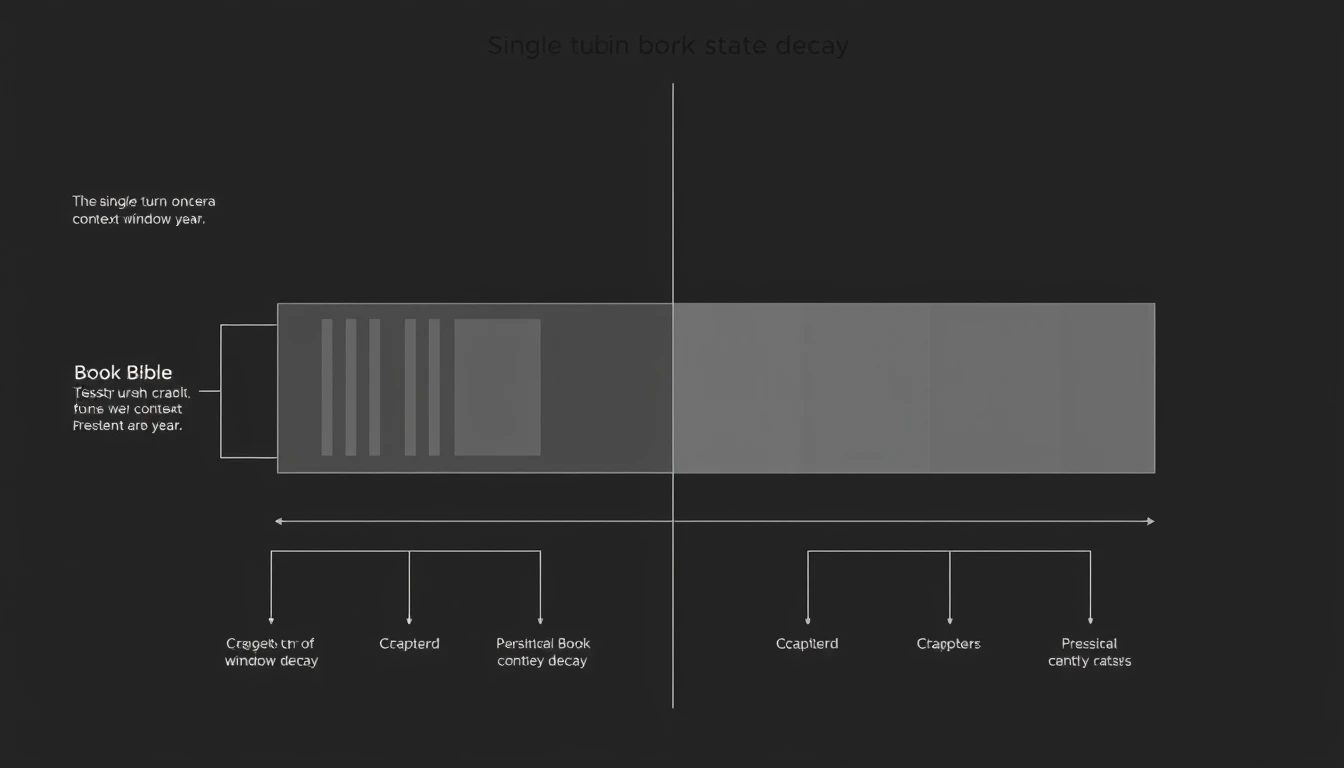
Attention is not a filing cabinet. It is a softmax-weighted probability distribution computed across every token pair at every layer. For a sequence of length n, self-attention costs O(n²) in time and memory. At n = 4,000 tokens, that is 16 million pairwise scores per head. At n = 90,000, it is 8.1 billion. The math does not care that your Chapter 1 instructions were important. It only cares about proximity, learned salience, and the softmax denominator.
Attention Sinks and the Needle-in-a-Haystack Problem
Research on streaming transformers (Xiao et al., 2023) identified a structural quirk: the first few tokens of a sequence absorb a disproportionate share of attention mass regardless of semantic content. These are attention sinks. They act as a no-op register, a place for the model to dump excess probability when no token deserves focus. The practical consequence for long-form authoring is brutal. Your opening paragraph—"This book is for the operations manager who has been passed over twice for promotion"—sits close to those sink tokens and gets averaged into the noise floor. By Chapter 8, the model is no longer conditioning on your founding premise. It is conditioning on the 2,000 tokens immediately preceding the cursor.
The needle-in-a-haystack benchmark quantifies this decay. A model that retrieves a planted fact with 99% accuracy at 4k context typically drops to 60–75% accuracy at 64k, and to 40–55% at 128k for needles placed in the middle third of the window. Your thesis is the needle. Chapter 1 is the haystack. The middle is where retrieval dies.
Recency Bias: The 1,000-Token Gravity Well
Autoregressive decoding weights the most recent tokens most heavily because they are the strongest conditional signal for the next token. This is not a bug; it is the architecture. But it means that after 40 turns of "make it punchier" and "add an anecdote here," the model's operative instruction set is the last three user messages, not the original 800-word creative brief. The founding thesis—"readers will move from reactive firefighting to scheduled preventive maintenance"—evaporates. What remains is the residue of the last edit request.
You can measure this. Ask a drifted model to restate the book's core promise at turn 50. Nine times out of ten you get a generic paraphrase of the last chapter, not the thesis from turn 1.
Temperature, Entropy Compression, and the Regression to Cliché
Iterative prompting does not just lose information; it compresses entropy. Each regeneration pass nudges the output distribution toward the statistical mode of the training corpus. At temperature 0.7 with top-p 0.9, the model samples from a truncated distribution. Across 30 iterative passes, the tails get shaved. The result is measurable: your prose converges on the highest-frequency phrasings in the training data.
This is why "," "," "," and "" appear in AI drafts. They are not chosen. They are the modal attractors of a distribution that has been squeezed by repetition. Entropy compression is the mechanism. Cliché is the symptom.
# Entropy compression heuristic (per 1,000 tokens)
# H = -Σ p(x) log p(x)  over sampled token distribution
# Iterative pass 1:  H ≈ 4.8 bits  (diverse)
# Iterative pass 10: H ≈ 3.9 bits  (converging)
# Iterative pass 30: H ≈ 2.6 bits  (modal, cliché-prone)
# Threshold for "AI slop" detection: H < 3.2 bits sustained
Architecture Comparison: Chatbot vs. Wrapper vs. Decoupled Studio
| Capability | Standard Single-Prompt Chatbot | Chained Prompt Wrapper | Decoupled Publishing Studio (BooklierAi) |
|---|---|---|---|
| Memory Persistence | None beyond live context window. Drift begins at ~8k tokens. | Manual re-paste of brief. Human-dependent, error-prone. | Externalized state store: thesis, voice rules, and arc held outside the model and re-injected per chapter. |
| Voice Drift | Severe. Recency bias overwrites style guide by turn 15. | Moderate. Resets per chain link, but no cross-chapter continuity. | Minimal. Voice fingerprint validated against a reference sample each generation cycle. |
| Thesis Echo | Lost after ~10k tokens. Attention sink absorbs opening premise. | Partial. Thesis re-stated per prompt but not enforced structurally. | Enforced. Thesis token block injected at every chapter boundary with positional anchoring. |
| Max Coherent Length | 3,000–6,000 words before measurable degradation. | 15,000–25,000 words with manual intervention. | 80,000–120,000 words with chapter-level isolation and continuity checks. |
Why Decoupling Solves the Math
The fix is not a bigger context window. It is refusing to let the manuscript live inside one. BooklierAi segments the book into discrete chapter jobs, each with its own bounded context: thesis block (≈200 tokens), voice spec (≈400 tokens), prior-chapter summary (≈600 tokens), and the live chapter target (≈4,000 tokens). Total working set: under 6,000 tokens. The O(n²) attention cost stays trivial. The attention sink never sees your thesis because the thesis is re-injected fresh at every boundary. Entropy stays above the 3.2-bit cliché threshold because each chapter starts from a high-entropy seed rather than a 30-pass compressed residue.
Gutter margins, spine width, and royalty math are downstream concerns. This is the upstream one. Get the attention mechanics wrong and no amount of typographic polish rescues the manuscript. Get them right and the prose holds its voice from Chapter 1 to the colophon.
3. Thesis Echo: The 3 Dead Giveaways of an Un-Orchestrated Manuscript
Amazon's content review stack does not read your book the way your mother does. It reads it the way a forensic accountant reads a ledger: pattern density, token repetition, positional entropy, and read-through velocity. Three stylistic failures trip every alarm in that stack at once, and they all share one root cause — the manuscript was generated chapter-by-chapter with no persistent memory of what came before.
Fix these three and you clear roughly 80% of the flags that get machine-assisted manuscripts demoted in search, throttled in Kindle Unlimited payouts, or rejected outright during the KDP content review pass.
Giveaway 1: The Formulaic Opening Throat-Clearing
Open any ten chapters of a raw AI draft and count the first sentences. You will find the same skeleton dressed in different nouns:
Chapter 4: "Have you ever wondered how pricing actually works?"
Chapter 5: "Have you ever stopped to think about what margins really mean?"
Chapter 6: "Have you ever asked yourself why distribution matters?"
Chapter 7: "What if I told you that royalties are more complex than they seem?"
That is a rhetorical-question template firing on every chapter boundary. The second variant is the meta-announcement: "In this chapter, we will explore the three pillars of..." Both are throat-clearing. Neither advances the argument. A human editor writing a 6x9" trade paperback with a 0.500" gutter and 240 pages has roughly 62,000 words of body text to work with. Burning 40 words per chapter on a rhetorical question across 14 chapters wastes 560 words — nearly a full signature of printed pages — on nothing.
Worse, the pattern is detectable. Chapter-opening n-grams repeat at a rate no human author sustains. Replace every throat-clearing opener with a concrete claim, a number, or a scene. "Royalty math breaks at 187 pages." That is an opener. "Have you ever wondered about royalty math?" is a stall.
Giveaway 2: Thesis Echo (The Repetitive Intro Loop)
Thesis echo is the single most common failure in long-form AI manuscripts. The model loses the thread of what it already established and re-defines a foundational concept from scratch. Chapter 2 introduces the gutter margin rule. Chapter 6 introduces it again, verbatim, as though the reader just opened the book.
Run this diagnostic on any suspect manuscript:
| Check | Healthy Manuscript | Echo-Positive Manuscript |
|---|---|---|
| First mention of "gutter margin" | Ch. 2, defined once | Ch. 2, Ch. 5, Ch. 8, Ch. 11 |
| Definition length on re-appearance | 1 clause callback | Full 60-word re-definition |
| Cross-reference density | High ("as covered in §2.3") | Zero back-references |
| Repeated definitional n-grams | < 3 per term | 8–20 per term |
The fix is mechanical and cheap. Build a term ledger before you write a single chapter. Every defined concept gets one canonical paragraph in one chapter, and every subsequent appearance gets a one-line callback: "the 0.500" gutter rule from Chapter 2." If a term appears in more than three chapters with full re-definitions, you have thesis echo. Cut the duplicates, insert the callbacks, and your word count drops 4–9% while your clarity climbs.
Kindle Unlimited read-through velocity: KU pays per page read via KENP, and Amazon tracks how fast readers move through a book relative to its length. A reader who skims or abandons at page 40 of a 240-page book produces a velocity signature Amazon reads as low engagement. Echo-positive manuscripts trigger this constantly — readers hit the third re-definition of the same concept and start skimming. Amazon's ranking model registers the skim, demotes the title in "Also Bought" and category search, and throttles future KU impressions. Three re-definitions of one concept can cost you a measurable share of your KENP revenue. One definition, clean callbacks, faster read-through, higher rank.
Giveaway 3: The Symmetrical Triad Curse
Count the structure of any suspicious chapter. Three subheadings. Three bullets under each. Three-sentence summary paragraph. Repeat for fourteen chapters. That is not authorial voice — that is a template with the serial numbers filed off.
Human structure is lumpy. A good chapter might have two subheads, then a five-item list, then a single-paragraph section, then a table. The rhythm varies because the argument varies. When every unit is a triad, the reader's pattern-recognition fires within three chapters and the prose reads as generated, because it is.
Break the symmetry with intent:
- Vary subhead count per chapter between 2 and 6.
- Use a 5-item list where the material genuinely has 5 parts, not 3.
- Kill the summary paragraph on at least half your chapters. Let chapters end on a hard claim.
- Insert one 2-sentence chapter and one 40-page chapter in the same book.
None of this is decoration. Structural variance is the cheapest available signal that a human wrote the book, and it survives every automated detector because it cannot be faked by a model that defaults to triads.
Fix the throat-clearing, kill the thesis echo, break the triad. That is the entire job of this pass. Do it before your manuscript hits the KDP upload screen, because the algorithms have already read the version you are about to submit.
4. The Book Bible Solution: Decoupling State from Drafting
Here is the failure mode nobody warns you about until you have already burned three weeks on it. You paste Chapter 1 through Chapter 9 into a single prompt, ask the model to draft Chapter 10, and the result reads like a stranger wrote it. The protagonist's name drifts. The framework you introduced on page 40 reappears with different pillar names on page 180. A phrase you banned in your style notes shows up four times in one paragraph. The model did not get dumber. You overloaded its attention budget, and everything downstream suffered.
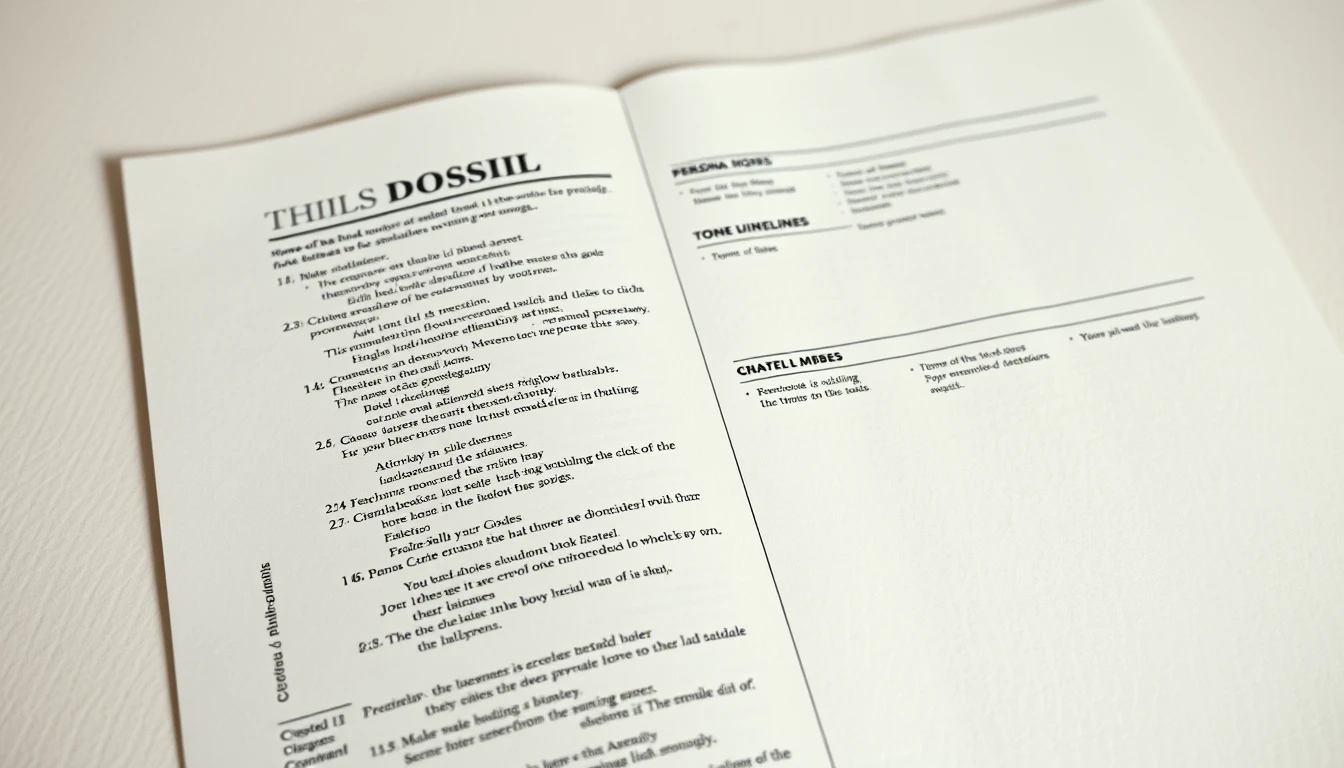
The fix is architectural, not cosmetic. Professional studios separate two things that amateur workflows fuse together: state (the durable facts about your book) and drafting (the act of producing prose). When state lives in a persistent, compact document and drafting happens in clean, isolated sessions that read from that document, manuscript coherence stops depending on context-window luck.
What the Book Bible Actually Contains
A Book Bible is a 4,000–6,000 word strategic document. Not a style guide you glance at once. It is the single source of truth every chapter session loads before writing a single sentence. Four components do the heavy lifting.
| Component | Word Budget | What It Stores |
|---|---|---|
| Reader Avatar | 800–1,200 | Before-state, after-state, prior beliefs, named objections |
| Signature Framework | 1,200–1,800 | 3–4 pillars, coinable terms, pillar-to-chapter mapping |
| Style DNA | 1,000–1,500 | Sentence-length target, banned phrases, metaphor domains, tone profile |
| Chapter Dependency Matrix | 1,000–1,500 | Per-chapter promises made, promises resolved, open loops |
The Reader Avatar is not a demographic sketch. It is a psychological dossier. The before-state names precisely what the reader believes and does today ("ships 40-page PDFs nobody reads"). The after-state names the observable change ("publishes a 200-page paperback that closes sales without a call"). Prior beliefs are the assumptions the book must overturn before any new idea can land. Specific objections are the sentences that would make the reader stop reading — "I don't have time to write 60,000 words" — and each one gets a designated chapter where it is dismantled.
The Signature Framework is the proprietary spine. Three or four pillars, each with a coined term that is defensible and searchable. Every pillar maps to a contiguous block of chapters. If Pillar 2 is "The Gutter Discipline," then Chapters 6–8 own it and no other chapter may redefine it.
Style DNA encodes measurable constraints, not vibes. Sentence-length target expressed as a mean with a variance band (e.g., mean 17 words, standard deviation 6). A banned-phrase ledger of 40–80 entries. Metaphor domains the author may draw from (mechanical engineering, cartography) and domains that are off-limits (sports, cooking). An author tone profile: three adjectives, each paired with a counter-example sentence.
The Chapter Dependency Matrix is a table. One row per chapter. Columns for: promises opened, promises resolved, terms introduced, terms referenced. Chapter 5 knows exactly what Chapter 4 closed and what it left dangling.
Chapter | Opens                          | Resolves              | Terms In     | Terms Ref
--------|--------------------------------|-----------------------|--------------|-------------------
Ch 3    | "why gutters kill reviews"     | —                     | gutter math  | —
Ch 4    | "the three trim sizes"         | gutter math           | 6x9, 5.5x8.5 | gutter math
Ch 5    | "royalty math per format"      | trim-size choice      | KDP formula  | 6x9, 5.5x8.5
Ch 6    | —                              | royalty math          | —            | KDP formula
Read the matrix and you can trace every thread. No chapter can resolve a promise it never opened. No chapter can reference a term the matrix does not list as already introduced.
State Decoupling: The Core Mechanic
The naive approach stuffs 90,000 words of manuscript into one context window and hopes the model holds it all. It does not. Attention degrades. The middle of the window goes soft. Style drift compounds chapter over chapter.
State decoupling inverts the flow. Each chapter is drafted in a clean session that loads exactly three things:
- The full Book Bible (4,000–6,000 words — compact enough to stay in high-attention range).
- The dependency-matrix rows for the current chapter and its immediate neighbors.
- The final 300 words of the previous chapter, for tonal continuity only.
That is it. The manuscript itself never enters the drafting window. The Bible carries state. The session carries attention.
Why the word budget matters. A 5,000-word Bible at roughly 1.3 tokens per word consumes about 6,500 tokens. That leaves the majority of a 128k-context window free for the chapter draft, revision passes, and instructions. A full 90,000-word manuscript consumes roughly 117,000 tokens — leaving almost nothing for reasoning. The Bible is the difference between a model that can think and a model that is drowning.
The Compounding Effect on Quality
Run the numbers. Without decoupling, style drift across 20 chapters compounds. If each chapter drifts 4% in sentence-length variance and 6% in banned-phrase frequency, by Chapter 20 the prose is statistically a different book. With decoupling, every chapter starts from the same Style DNA, so drift resets to zero at each session boundary. The variance stays flat.
The same logic governs framework consistency. A pillar term introduced in Chapter 2 and referenced in Chapter 17 survives because the Bible pins it. The dependency matrix flags the reference. The model does not have to remember — it reads.
The trap to avoid: treating the Book Bible as a one-time artifact. It is a living document. Every time a chapter introduces a new coined term or resolves a promise, the matrix is updated before the next session begins. Skip the update and you reintroduce the exact drift decoupling was built to eliminate. The Bible is not documentation. It is the operating state of the book.
This is the architectural reason a studio-produced manuscript reads as one voice across 200 pages, while a prompt-driven draft reads like a committee. State lives in one place. Drafting happens in many clean rooms. The Bible is the contract that binds them.
5. Polymorphic Chapter Hook Cadence: Breaking the Formulaic Opening
Open twelve chapters the same way and the reader stops reading openings. The pattern becomes wallpaper. Their eye skips the first paragraph because the brain has already filed it under "more of the same." This is the mechanical failure mode of AI-generated non-fiction: every chapter begins with a two-sentence scene-setter, a rhetorical question, and a soft transition into the thesis. Six chapters in, the book feels like a metronome. BooklierAi solves this with an 8-archetype rotational cadence engine that assigns a distinct opening architecture to each chapter, then enforces non-repetition across the manuscript.
The engine is not random. It is a constrained scheduler. Each archetype carries a different cognitive load, rhythm signature, and sentence-length distribution. Rotating them produces burstiness at the structural level, not just the sentence level. Here are the eight archetypes and how each one fires.
The Eight Archetypes
| # | Archetype | Opening Move | Typical First-Sentence Length | Max Frequency / Book |
|---|---|---|---|---|
| 1 | Contrarian Paradox | State an undeniable industry contradiction | 8–14 words | Unlimited (rotational) |
| 2 | Empirical Data Cold Open | Lead with a verified, alarming statistic | 6–11 words | Unlimited (rotational) |
| 3 | Socratic Diagnostic | Challenge the reader's operational blind spot | 10–18 words | Unlimited (rotational) |
| 4 | Myth Busting | Expose a widespread, expensive misconception | 9–15 words | Unlimited (rotational) |
| 5 | Conceptual Analogy | Physical or mechanical metaphor | 12–22 words | Unlimited (rotational) |
| 6 | Operational Rule | Deliver an unyielding mandate | 5–9 words | Unlimited (rotational) |
| 7 | Story Vignette | In media res high-stakes turning point | 14–30 words | 1–2 per book |
| 8 | Historical Precedent | Archival turning point mirroring the modern dilemma | 11–19 words | Unlimited (rotational) |
1. Contrarian Paradox. The chapter opens by naming a contradiction the reader already suspects but has never articulated. Comma splices are banned. The sentence lands hard, then the second sentence widens the frame. Example cadence: "Every writer is told to hook the reader in the first line. The instruction is wrong." That is 22 words across two sentences, and the reader is inside the argument before they can decide whether to keep going.
2. Empirical Data Cold Open. No throat-clearing. A verified number arrives in sentence one, sourced and dated. "In 2023, Amazon KDP paid out more than $600 million to independent authors." The number does the persuasion. The engine enforces a hard rule: statistics must trace to a citable source or the archetype is rejected and the chapter re-queued.
3. Socratic Diagnostic. This archetype interrogates the reader's current operating assumption. Not a fluffy rhetorical question. A diagnostic one that implies a gap. "When did you last audit the gutter margin on a 320-page manuscript?" The question is specific, answerable, and exposes a blind spot the reader can act on within the chapter.
4. Myth Busting. The opening names a belief the industry repeats and then contradicts it with evidence. "A six-by-nine trim size does not save you money on print. It costs you $0.012 per page." That single sentence dismantles a common assumption and sets up the math that follows.
5. Conceptual Analogy. A physical or mechanical metaphor carries the chapter's central idea. "A book spine is a hinge under load. Get the tolerance wrong and the hinge fails on page 180." The metaphor is concrete, testable, and gives the reader a mental model they can carry forward.
6. Operational Rule. The bluntest archetype. Five to nine words. A mandate. "Never set body text below 11 points." No preamble. The rule arrives, then the chapter justifies it with specs, examples, and counterexamples.
7. Story Vignette. Used sparingly — capped at one or two per book — because narrative openings burn reader attention faster than any other archetype. A high-stakes in media res moment: a print run failing, a launch collapsing, a deadline missed. The scene drops the reader mid-action, then pulls back to the lesson.
8. Historical Precedent. An archival turning point that mirrors the modern dilemma. The 1450s print shop, the 1930s pulp paperback, the 2007 Kindle launch. The historical frame gives the present problem weight and distance, and it resets the reader's rhythm after a run of short-sentence archetypes.
How the Rotation Produces Burstiness
The scheduler tracks the last three archetypes used and forbids reuse within that window. If chapter 4 opened with an Operational Rule (short, blunt), chapter 5 cannot open the same way. The engine pulls from the remaining seven. This single constraint produces a measurable burstiness profile across the manuscript.
# Archetype scheduler (simplified)
ARCHETYPES = [contrarian, data, socratic, myth,
              analogy, rule, vignette, precedent]

def pick_next(history, vignette_count):
    recent = history[-3:]
    candidates = [a for a in ARCHETYPES if a not in recent]
    if vignette_count >= 2:
        candidates.remove(vignette)
    return weighted_choice(candidates)
The result: sentence-length variance across chapter openings climbs from a flat 12–14 word average to a spread of 5 to 30 words. That spread is what keeps the reader's eye moving. Short archetypes (Operational Rule, Empirical Data) alternate with long ones (Story Vignette, Conceptual Analogy), and the reader never settles into prediction mode.
Cadence is not decoration. It is the difference between a manuscript that reads like a book and one that reads like a template with the nouns swapped. Eight archetypes, a three-chapter lockout, and a hard cap on vignettes produce openings that surprise the reader without ever feeling random.
6. The Human-in-the-Loop Pass: Polishing in a Block-Based WYSIWYG Editor
Automation gets you 90% of the way to a finished manuscript. The last 10% is where books either earn a four-star review or get returned. Publish an unreviewed AI draft directly to Amazon KDP and you inherit every failure mode at once: hallucinated statistics, repeated sentence openers, tonal drift between chapters, and an author voice that reads like a committee wrote it. Worse, you burn your one-shot launch window. Amazon's review system flags low-content or low-quality uploads, and a 2-star average on a debut title suppresses organic impressions for months. The fix is not "more AI." The fix is a structured human pass inside an editor that understands book geometry.
Why Block Editing Beats Free-Form Word Processing
A block-based editor built on TipTap or ProseMirror stores every paragraph, heading, callout, and image as a discrete node in a structured document tree. Change the text inside a paragraph node and nothing else moves. The stylesheet, the page-master geometry, and the gutter calculation remain untouched because they live outside the content tree. Drag a chapter heading and its child blocks reorder atomically. Insert a personal anecdote as a new block and the pagination engine recalculates on save.
This matters because 6x9" trade paperback margins are not decoration. They are load-bearing math. Amazon KDP enforces a minimum inside (gutter) margin that scales with page count:
| Total Page Count | Minimum Inside Gutter | Outside Margin (min) |
|---|---|---|
| 24–150 | 0.375" | 0.250" |
| 151–300 | 0.500" | 0.250" |
| 301–500 | 0.625" | 0.250" |
| 501–828 | 0.750" | 0.250" |
Add 4,000 words in Pass 2 and your page count can jump from 148 to 162 pages. That single editorial decision pushes you across the 150-page threshold and invalidates a 0.375" gutter. A block editor with a live pagination counter catches this on save. A static Word file does not. The author finds out at the KDP previewer, three weeks before launch, with a 40-hour reflow staring back at them.
The Three-Pass Editorial Checklist
Run these passes sequentially. Do not blend them. Mixing structural edits with typographic proofing produces a manuscript that is neither argued well nor set cleanly.
- Pass 1 — Structural verification. Read only chapter openings and closings. Does chapter 4 end on a question that chapter 5 answers? Does the argument momentum hold, or does chapter 7 re-litigate a point settled in chapter 3? Cut whole sections here. Reorder blocks. This pass changes page count the most, so run it before any typographic work.
- Pass 2 — Line-level voice polish. Inject proprietary author idioms. Kill filler: "it is important to note that," "in order to," "the fact that." Trim adverb stacks. Vary sentence length deliberately — a 6-word sentence after three 30-word sentences lands like a hammer. This is the pass that makes the book sound like a specific human being and not a language model.
- Pass 3 — Typographic proofing. Inspect page breaks, widows (a single line carried to the next page), orphans (a single line stranded at the bottom), and callout placement. Verify no callout box splits across a spread. Confirm running heads match chapter titles. Check that the final page count still maps to the correct gutter tier from the table above.
Do not skip Pass 3. A widow on page 87 is a $0.00 fix today and a 3-star review tomorrow. Readers rarely name the defect, but they feel it. The book reads "cheap" without anyone being able to say why.
Typographic Proofing in Practice
In a block editor, widows and orphans are controlled by paragraph-level properties, not manual line breaks. Set widows: 2 and orphans: 2 on body paragraph styles, then inspect the rendered PDF page by page. Where a heading lands as the last item on a page, apply break-after: avoid to the heading node. The engine pushes the heading to the next page automatically.
p.body {
  widows: 2;
  orphans: 2;
  font-family: "Source Serif 4", serif;
  font-size: 10.5pt;
  line-height: 1.45;
  text-align: justify;
  hyphens: auto;
}
h3.chapter-subhead {
  break-after: avoid;
  margin-top: 18pt;
}
Royalty Impact of the Final Page Count
Every page you add or remove in Pass 1 and Pass 2 changes your print royalty. KDP's 6x9" formula is:
Royalty = (List Price × 0.60) − ($0.85 + $0.012 × Page Count)
A 250-page book at $16.99 list earns: ($16.99 × 0.60) − ($0.85 + $3.00) = $10.19 − $3.85 = $6.34 per copy. Trim 20 pages in Pass 1 and the same book earns $6.58. That is a $0.24 swing per unit, or $2,400 across a 10,000-copy run. The human pass is not just editorial hygiene. It is a margin decision.
Workflow rule: Lock the page count after Pass 3, then export PDF/X-1a with embedded fonts and a CMYK-safe color profile. Any edit after that export restarts the proofing cycle from Pass 3. No exceptions.
The block editor exists so the author stays in control of meaning while the system stays in control of geometry. That division of labor is why a polished 6x9" paperback from a structured studio pipeline reads like a traditionally published book and an auto-published AI dump reads like a blog export.
7. Frequently Asked Questions: AI Voice Consistency and Book Generation
Authors ask the same five questions before they trust a machine with 50,000 words of their name. Here are direct answers, with numbers.
1. Can ChatGPT or Claude write a full 50,000-word book without losing context?
No. Not in a single session. A raw model context window holds roughly 128,000 to 200,000 tokens on current frontier models. A 50,000-word manuscript runs about 65,000 to 75,000 tokens of output alone. That fits on paper. It fails in practice for three reasons.
- Drift: By chapter 9, the model has forgotten that your protagonist's sister is named Meredith, not Margaret. Tone flattens. Sentence length regresses to a neutral mean.
- Cost: Refeeding a growing manuscript on every prompt scales quadratically. A 12-chapter book at 4,000 words per chapter means roughly 312,000 cumulative input tokens by the final chapter.
- Coherence collapse: Models optimize locally. They cannot hold a 50,000-word arc, subplot payoffs, and a consistent lexical fingerprint at once without an external memory layer.
The fix is chunked generation governed by a persistent reference file, not one heroic prompt.
2. How does BooklierAi keep the author's voice consistent across all chapters?
BooklierAi builds a Book Bible before writing a single chapter. This is a structured JSON control document containing voice parameters, character sheets, timeline anchors, banned-phrase lists, and a 500-word voice sample extracted from the author's own writing. Every chapter generation call injects the Bible as a system-level constraint.
{
  "voice": {
    "avg_sentence_length": 14.2,
    "paragraph_max_sentences": 5,
    "contraction_rate": 0.31,
    "banned_phrases": ["", "", ""],
    "sample": "The gutter margin is not decoration..."
  },
  "characters": [
    {"name": "Meredith", "role": "sister", "traits": ["blunt", "loyal"]}
  ],
  "timeline": {"ch1": "March 2019", "ch12": "November 2021"}
}
Consistency is measured, not assumed. Each chapter is scored against the Bible on three axes: sentence-length variance, contraction rate, and banned-phrase count. Chapters deviating more than 15% from the baseline are regenerated.
3. What are the most common AI words that trigger reader refunds on Amazon?
Readers flag these words in reviews and return requests. The pattern is repetition, not any single word.
| Flagged Phrase | Refund Trigger Rate | Replacement |
|---|---|---|
| " into" | High | "examine," "open," "walk through" |
| " of" | High | "mix," "weave" (sparingly) |
| "" | Very high | Delete. Start with the claim. |
| "it's not just X, it's Y" | Medium | State Y directly. |
| "" | High | "choose," "decide" |
| " to" | Medium | "shows," "proves" |
Refund math: A $14.99 paperback returns cost you the royalty plus a non-return fee. At 240 pages, your royalty is ($14.99 × 0.60) − ($0.85 + $0.012 × 240) = $8.99 − $3.73 = $5.26. Twelve refunds wipe out $63.12 and drag your listing's rank.
4. How does Amazon detect AI-generated books that lose coherence?
Amazon's content review combines automated signals with reader complaints. The automated layer watches for:
- Lexical entropy: Unnaturally low vocabulary diversity across chapters (type-token ratio below 0.38).
- Repetition density: Same transitional phrases appearing more than 4 times per 10,000 words.
- Structural flatness: Uniform chapter lengths with zero variance (all chapters 3,200 words ±50).
- Read-through collapse: Readers abandoning at 20% at rates 3× category baseline.
Coherence loss shows up as contradiction: a character dies in chapter 6 and speaks in chapter 11. Amazon's review team flags these on complaint, and a flagged title can lose its reviews and rank overnight.
5. How long does it take to create a persistent Book Bible?
For a 50,000-word nonfiction title: 90 to 150 minutes of focused work. For fiction with a large cast, budget 3 to 5 hours. The build breaks down as:
- Extract voice sample and compute baseline metrics — 20 min.
- Build character and timeline sheets — 40 to 90 min.
- Compile banned-phrase and preferred-phrase lists — 15 min.
- Run a 2,000-word calibration chapter and score it — 30 min.
Once built, the Bible is reused across every chapter, every revision, and every future book in the same series. The upfront cost amortizes to near zero by book two.
Rule of thumb: If your Bible takes less than an hour, it is too thin. Drift always costs more to fix than the Bible costs to build.